
Storage Price Increases Lead the Cycle, Domestic Breakthroughs Coexist with External Constraints
Update time : 2026-02-06
In February 2026, the global chip industry focused on the imbalance between supply and demand of memory chips, fluctuations in the performance of giants, and technological iteration. At the same time, domestic chips continued to make breakthroughs, and the impact of geopolitics persisted, making the industry show a pattern of "challenges coexisting with opportunities".
In the memory chip sector, shortage and price increase have become the core keywords. On February 1, Samsung Electronics took the lead in announcing a sharp increase in NAND flash chip prices by as much as 100%, officially kicking off a new super cycle of memory chips. International memory giants such as Micron and Kioxia plan to follow up with price increases. Intel CEO Patrick Gelsinger even stated at a Cisco conference that the memory chip shortage will not ease until at least 2028, and there are currently no effective mitigation measures. This judgment is 2-3 years later than previously expected by the market, highlighting the severity of the current supply-demand imbalance. Affected by this, global mobile phone manufacturers are facing cost pressures and have successively cut orders, which has further transmitted to the performance of chip giants.
For chip giants, negative news came during the US stock earnings season. On February 5, Qualcomm, a US chip giant, saw its stock price plunge by more than 12% in pre-market trading of US stocks, with a decline of 11.18% as of press time. The core reason is that its 2026 fiscal year Q2 performance guidance was lower than market expectations, and the mobile phone chip revenue guidance was reduced to 6 billion US dollars. Qualcomm executives explained that the surge in demand for storage from AI data centers has squeezed the supply and cost space of mobile phone manufacturers. Many manufacturers have reduced mobile phone production plans and cleared channel inventory, and this impact may last for the rest of the fiscal year. On the same day, the stock price of Arm, a British chip design giant, also plummeted by more than 8% at one point. Although its Q3 revenue slightly exceeded expectations, the license revenue, a key indicator of future design adoption rate, was lower than expected, triggering market sell-off. In addition, Infineon, a giant in power semiconductors, announced on February 5 that it will increase the price of power switches and related chips starting from April 1, 2026, to cope with the pressure of tight supply and rising costs.
Technological iteration and production capacity layout are advancing simultaneously. On February 1, Nvidia launched the new generation HBM3e memory chip at the GTC 2026 special event, with a single chip capacity of 64GB, a bandwidth increase of 40% to 1.2TB/s, and a power consumption reduction of 25%, suitable for AI training and high-performance computing scenarios. It plans to cooperate with TSMC to expand production capacity, with mass production expected in Q3 2026. Intel announced an investment of 40 billion US dollars to expand wafer fabs in the United States, focusing on 2nm and more advanced processes, with full production expected in 2028. At the same time, it cooperates with Micron to develop 2nm-level memory and logic chip integration technology to enhance local manufacturing capabilities. In addition, Intel plans to cooperate with Saimemory, a subsidiary of SoftBank, to develop a new generation of memory technology called ZAM, with a maximum single-chip capacity of 512GB and power consumption 40% to 50% lower than the current mainstream HBM memory, which is expected to reshape the memory market pattern in the AI era. TSMC plans to build a second factory in Kumamoto, Japan, to mass-produce 3nm chips to meet the surging demand for AI chips, with an investment of about 17 billion US dollars. It also announced that it will continue to increase the quotation of advanced processes below 7nm in 2026, with an expected increase of 3% to 10%, marking the fourth consecutive year of price increases.
The domestic chip sector has continued to make breakthroughs while facing external constraints. On January 30, Xindong Technology launched the world's first 120-channel PCIe Gen5 switch chip GX9120, manufactured with 12nm process, with a bandwidth of 3.84TB/s, breaking overseas monopoly and obtaining orders from many leading server manufacturers. On the same day, the total shipment of Alibaba Pingtouge Zhenwu PPU chips exceeded 100,000 units, leading the domestic GPU market. The performance of this chip is comparable to Nvidia H20, and it has served more than 400 leading customers. Montage Technology launched its Hong Kong IPO on January 30, planning to raise funds to expand HBM memory interface chips and AI chip businesses, achieving an "A+H" listing layout. Its DDR5 memory buffer chip has a market share of over 40%. In addition, domestic chip manufacturers such as Guoke Microelectronics and Sino-Micro Semiconductor have raised prices intensively to cope with supply gaps and cost pressures, among which the maximum increase of Guoke Microelectronics' co-packaged KGD chips reached 80%. However, external constraints remain. On January 31, the U.S. Department of Commerce expanded AI chip export controls, adding 3 Chinese AI chip design enterprises to the entity list and restricting their access to advanced processes and key technologies. At the same time, the sales of Nvidia H200 chips to China have stagnated due to U.S. security reviews, increasing industry uncertainty.
In terms of market performance, A-shares and Hong Kong stocks showed a differentiated trend. On the afternoon of February 5, the A-share chip industry chain rebounded oscillatingly, led by the analog chip sector. Guoxin Technology rose by more than 10%, and many individual stocks such as Yangjie Technology and Ruisong Technology rose by more than 8%. However, Hong Kong chip stocks performed weakly on February 4, with stock prices of Shanghai Fudan, Huahong Semiconductor, SMIC and other companies falling. Institutions predict that Broadcom and TSMC will become major winners in the custom chip field. Broadcom's market share in ASIC chips is expected to expand to 60% next year, while TSMC accounts for nearly 99% of the wafer manufacturing orders of the world's top ten data centers and ASIC customers.
Related News
Read More >>
 China's Domestic AI Chip Revenue Nearly Doubles in H1 as CXMT Mass-Produces LPDDR6 and Unveils 600k-Wafer Expansion Plan
18.09.2026
(September 18, 2026, Semiconductor Industry Review)Since the start of September,...
AI Computing Demand Sparks Global Chip Super Cycle; HBM Shortage and Supply Chain Restructuring Define Industry Challenges
20.08.2026
(August 17, 2026, Industry Report)In the second half of 2026, the global...
AI Demand Ignites a New Global Chip Race as 2-Nanometer Manufacturing and Advanced Packaging Become Key Battlegrounds
15.07.2026
July 15, 2026 — The continued expansion of artificial intelligence data centers,...
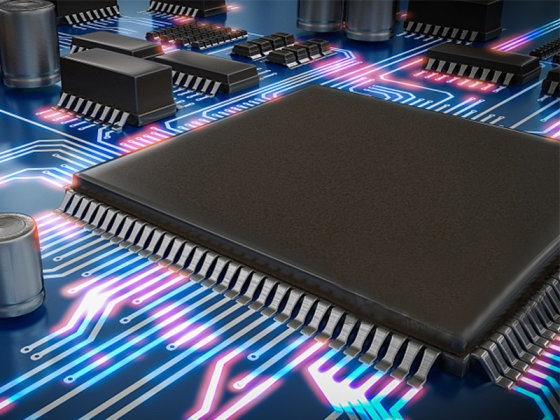 AI Demand Reshapes the Global Semiconductor Supply Chain as Memory and Advanced Packaging Become Key Battlegrounds
23.06.2026
The global semiconductor industry is entering a new phase of structural change...